Before 1 July 2026, an owner-builder selling a home had to be covered by the required domestic building insurance before sale and give the purchaser (prior to sale) a certificate of that insurance (former section 137B(2)(b) of the Building Act 1993 (Vic) (Building Act)). That insurance could only be claimed on if the owner-builder died, disappeared or became insolvent.
From 1 July 2026, section 137B(2)(b) requires the vendor to have complied with the requirements of the statutory insurance scheme (SIS)¹. The SIS is a scheme of first resort, meaning it doesn’t require the owner-builder to be dead, missing or insolvent before making a claim.
Great news for purchasers, right? Not necessarily, as the SIS is only required for a more limited range of owner-builder work when compared to the old regime.
Great news for vendors then? Again, no. The legislation solves some problems with the previous section 137B but owner-builder requirements still need to be carefully navigated prior to selling a property.
A section 32 that gets the owner-builder position wrong lets the purchaser avoid the contract at any time before settlement (section 137B(3)). The vendor also commits an offence (section 137B(2)). The LPLC sees many claims each year where the vendor’s solicitor did not properly advise their client about what an owner-builder vendor needs to include in the vendor statement, and these claims have been increasing as the property market has softened.
Legislative references in this article are to the Building Act, unless otherwise specified.
What's on this page?
- Differences between the old and new regime
- The decision flow, step by step
- Is section 137B triggered?
- Does the SIS apply to the owner-builder work?
- What is DBW?
- Was a CoC required?
- Where a CoC was obtained: the SIS applies and cover is available through distributors
- Where no CoC was obtained
- What to put in the section 32 statement
- FAQs
Differences between the old and new regime
Click here to view the table if you are reading this on a mobile.
| Issue | Then (before 1 July 2026) | Now (from 1 July 2026) |
| When the cover can be called on | Last resort. The purchaser could claim only if the owner-builder had died, disappeared or become insolvent: cl 20(2), Ministerial Order No. S 95 28 February 2024 (MO) | First resort. The purchaser and subsequent owners can claim for incomplete and/or defective work without the death, disappearance or insolvency of the owner-builder. |
| Value of building work that triggers cover | More than $16,000
There was no clear statutory method for calculating the value, so whether the owner’s own labour counted was uncertain. | More than $20,000 (sections 25B(2) and 137I(c)) The SIS does not apply to domestic building work where the cost is less than $20,000 or the prescribed amount (section 137J(d)). The value is calculated under a defined method: an estimate of labour and materials, plus GST, less chattels and excluded items, so the owner’s own labour counts. |
| Is a certificate of consent (CoC) needed to trigger the need for owner builder insurance cover? | No. The need for owner-builder warranty insurance turned on the value of the work, not on whether a CoC had been obtained (cl 5, MO) | Yes. The SIS applies to owner-builder work carried out under a CoC (s 137I(c)). |
| When is premium paid and how | Before entering the contract of sale and after obtaining the defects inspection report, the owner-builder paid the premium to an insurance agent acting on behalf of the VMIA to obtain the policy. | Before entering the contract of sale and after obtaining the defects inspection report, the owner-builder buys cover from a Building and Plumbing Commission (BPC) appointed distributor (the BPC does not sell it directly): apply, supply the building permit, CoC, certificates of compliance, rates notice, title and plan, and allow about three weeks. See list here: This mechanism was created by regulations passed on 30 June 2026. |
| What insurance document is required in the section 32 | A certificate of currency for the owner-builder warranty insurance (section 32B, Sale of Land Act 1962 (Vic) (SL Act)). | A notice of cover under the SIS (section 32B, SL Act) |
| Monetary cap per dwelling | $300,000 | $400,000 |
| Who the cover protects | The purchaser and subsequent owners within the cover period; the owner-builder cannot claim for their own work. | |
| What the cover covers | Non-structural defects for 2 years after the completion date and structural defects for 6 years after the completion date (cl 23, MO). | Non-major defects for 2 years after the completion date and major defects (structural or weatherproofing) for 6 years after the completion date of the Reg 8 of the Building (Statutory Insurance Scheme) Regulations 2026 (Vic) |
| Defects report when there are owner-builder works | Required. A report from a prescribed building practitioner is needed whenever the owner-builder has carried out work within the broad definition of construct, regardless of value or insurance (section 137B(2)(a)). | SAME |
| Section 137C statutory warranties | Apply to the work and run with the building to the purchaser and subsequent owners. Need to be included in the contract (section 137C). | SAME |
| Consequence of non-compliance | The purchaser may avoid the contract at any time before settlement (section 137B(3)), and the vendor commits an offence (section 137B(2)). | SAME |
The decision flow, step by step
When preparing a section 32, practitioners should ask the vendor what building work has been carried out at the property and by whom, and then work through the following decision flow before settling the statement.
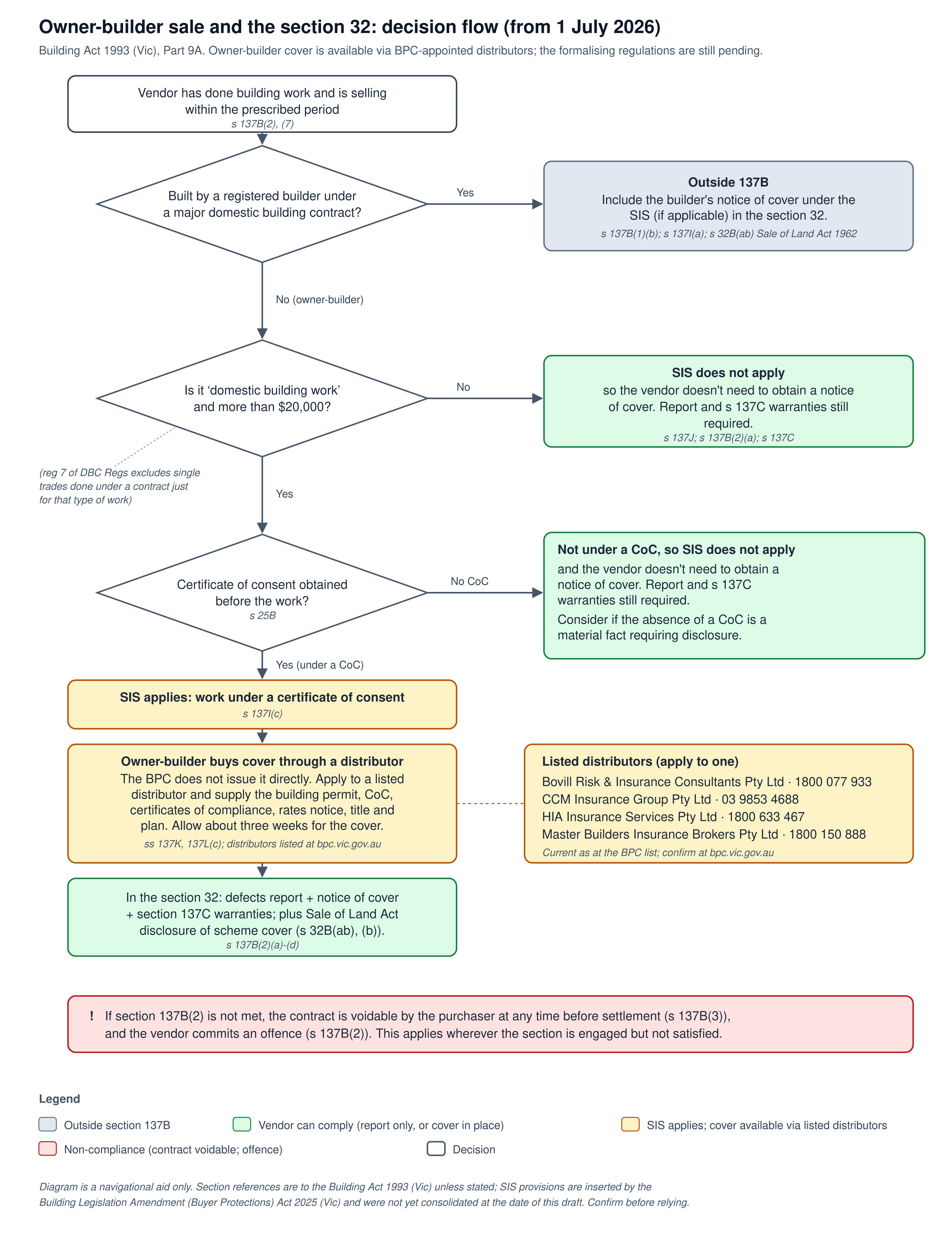
Click on the image above to view larger version.
Is section 137B triggered?
Section 137B applies to a person who “constructs” a building and sells within the “prescribed period” (defined as 6.5 or 7 years from commencement or completion, depending on whether a permit was required and obtained: sections 137B(2) and (7)). “Constructs a building” is defined broadly and includes renovating or altering a part of the building, and may include cosmetic works.
Owner-builder requirements do have some carve outs (section 137B(1)). For example, the owner-builder obligations do not apply to a home built by a registered builder under a major domestic building contract (MDBC), a non-home built by a registered practitioner or architect, a building already exempted by the Victorian Civil and Administrative Tribunal (VCAT) under the Domestic Building Contracts Act 1995 (Vic) (DBC Act), and a section 137E building.
If a carve-out applies, the owner-builder insurance requirement does not arise. Otherwise, continue.
Does the SIS apply to the owner-builder work?
The SIS applies to domestic building work (DBW) carried out under a CoC (section 137I(c)). The SIS also applies to work under an insurable domestic building contract and speculative work (section 137I(a) and (b)), which are building works done by a registered builder.
Three gateways decide whether owner-builder work is caught:
- whether it is DBW
- whether a CoC was required and obtained (section 137I(c))
- whether the work cost less than $20,000 (section 137J).
What is DBW?
DBW is defined by sections 5 and 6 of the DBC Act. The main exclusions to DBW:
- are work on a farm building
- a building used only for business
- a building used only for animals
- design work by an architect or engineer.
Regulation 7 of the Domestic Building Contracts Regulations 2017 (Vic) (DBC Regs) also excludes single-trade work such as:
- painting
- electrical work
- plumbing
- plastering
- tiling
- glazing
- floor coverings or insulating
but only where the work is done under a contract for that one type of work.
Was a CoC required?
A CoC is required where an owner-builder carries out DBW as a builder and the work costs more than $20,000 (section 25B(2)). The trigger is the value of the work, not whether a building permit is needed.
The threshold rose from $16,000 to $20,000 on 1 July 2026.
The $20,000 threshold is not measured by materials alone. The cost is calculated under the method in Subdivision 4 of Division 2 of Part 12 of the Building Act, and for owner-builder work it is the owner-builder’s estimate of the cost of labour and materials, plus GST, less chattels and prescribed excluded items (see also section 3A).
Because the owner’s own labour counts, a do-it-yourself job can pass $20,000 even where the materials cost less, and a building surveyor cannot accept the estimated cost where the given estimate is too low.
Where a CoC was obtained: the SIS applies and cover is available through distributors
Where the work was DBW, over $20,000 and a CoC was obtained, the SIS applies (section 137I(c) and regulation 8A of the Building (Statutory Insurance Scheme) Regulations 2026 (Vic)).
Owner-builders can purchase insurance from one of four distributors acting on behalf of the BPC (see list here: https://www.bpc.vic.gov.au/builders/builders-insurance/dbi-approved-distributors).
The regulations give the following example about the start date and duration of insurance:
A person constructs a home under a certificate of consent. The completion date is 1 July 2025. The home is sold and settlement of the contract of sale occurs on 1 August 2026. This is the cover start date. Cover under the statutory insurance scheme for domestic building work that is defective or non-compliant ends on 30 June 2027 (other than for major defects) or 30 June 2031 (for major defects).
To minimise the risk in delays to obtaining the relevant SIS policy for an owner-builder selling their property, before a contract of sale is entered into, solicitors should advise clients to email the insurer, obtain the relevant application form, and then provide the insurer with copies of requested documents which are likely to include their building permit, CoC, certificates of compliance, rates notice, title, and plan. Owner-builder clients need to allow at least three weeks for the insurance to be provided.
Where no CoC was obtained
Where the owner-builder work was DBW, and over $20,000 but no CoC was obtained in breach of the Building Act, then the owner-builder insurance trigger under section 137I(c) does not apply. This is because section 137B(2)(b) has been amended from "is covered by the required insurance" to "has complied with the requirements of the statutory insurance scheme".
If the SIS does not apply to the works no insurance must therefore be disclosed in the section 32 statement, under either section 137B of the Building Act or under section 32B of the SL Act.
Carrying out the work without a required CoC is an offence (section 25B(1)), but that offence is the owner’s personal regulatory breach. Solicitors should query whether in such circumstances, the failure to obtain the CoC would sufficiently affect the property to be a material fact to disclose (e.g. where it affected the quality of the work and means that there is no insurance cover for any defects).
What to put in the section 32 statement
Section 79 of the Buyer Protections Act amended the SL Act. It substituted section 32B(b) of the SL Act, so the vendor statement must now disclose where section 137B of the Building Act applies to the residence, particulars of any cover under the SIS applying to the residence. What to include depends on which branch of Figure 1 the matter falls in:
- Owner-builder insurance cover is in place: disclose the particulars of the SIS cover, attach the notice of cover (section 32B(b) of the SL Act), and attach the owner-builder condition report.
- Owner-builder work is $20,000 or under or is not DBW: disclose that no cover is required and attach the attach the owner-builder condition report only.
- Owner-builder work over $20,000 and was done without a CoC: attach the owner-builder condition report, which discloses the work, and note that no SIS cover is in place because the work was not done under a CoC.
FAQs
The vendor took out owner-builder warranty insurance in May 2026. Is it still good after 1 July?
Yes. A policy issued before the transfer date is taken to have been entered into by the BPC and is honoured (section 292 of the Building Act, inserted by the Buyer Protections Act). The transfer to the BPC cannot be treated as a breach, or as a reason to avoid the contract (section 298 of the Building Act).
The work was done in 2025, was over $20,000, no permit was required and no certificate of consent was obtained. Can the vendor still sell?
Yes. Where owner-builder works have occurred without a certificate of consent, then there is no obligation to obtain SIS insurance, and accordingly no need to comply with the owner-builder insurance requirements under section 137B.
However, in this situation, the owner-builder condition report must still be obtained and provided to the purchaser, before the vendor enters into the contract, and any contract of sale of land must contain the prescribed warranties under section 137C.
The work needed no building permit. Does that mean no certificate of consent was needed?
No. The certificate-of-consent trigger for owner-builders is the value of the work, being more than $20,000, not whether a permit was required (section 25B(1)).
¹ The SIS sits in Part 9A of the Building Act, inserted by section 56 of the Building Legislation Amendment (Buyer Protections) Act 2025 (Vic) (Buyer Protections Act)