The Windfall Gains Tax (WGT) under the Windfall Gains Tax Act 2021 (Vic) (WGT Act) commenced on 1 July 2023 and in broad terms, applies to land rezoned after that date.
What's on this page?
- Summary
- How does the tax work?
- Property subject to the tax
- Who is liable to pay WGT?
- When is WGT payable?
- Notification of errors in the notice of assessment - time limit
- Objection to the valuation of the land in the WGT Assessment – strict time limit
- Calculation of the WGT
- What is the WGT rate?
- Impact of section 10H of the Sale of Land Act 1962 (Vic) on conveyancing
- Risk management measures
- Resources
- Recorded webinar about Windfall Gains Tax
Summary
| The Windfall Gains Tax (WGT) applies to most land in Victoria rezoned after 1 July 2023 with some limited exceptions. | ||
| Most land in Victoria is susceptible to the WGT in the event of a rezoning. There are some limited exemptions for specific types of property and / or rezonings. | ||
| Land that was subject to a contract or option entered into before 15 May 2021 may not be subject to the WGT under transition concessions, provided the terms of the contract are not altered after that date and the transfer of the land has not occurred prior to the WGT event. | ||
| The owner of the property is liable for WGT. | ||
| Liability to pay WGT is incurred when the rezoning occurs but can be deferred for up to 30 years (and interest on the WGT liability will accrue). A first ranking charge in favour of the State Revenue Office will apply to the land until the WGT is paid. | ||
| Liability to pay WGT is incurred when the rezoning occurs but can be deferred for up to 30 years. A first ranking charge will apply to the land until the WGT is paid. | ||
| There is a strict 60 day time limit to object to an assessment for WGT. |
How does the tax work?
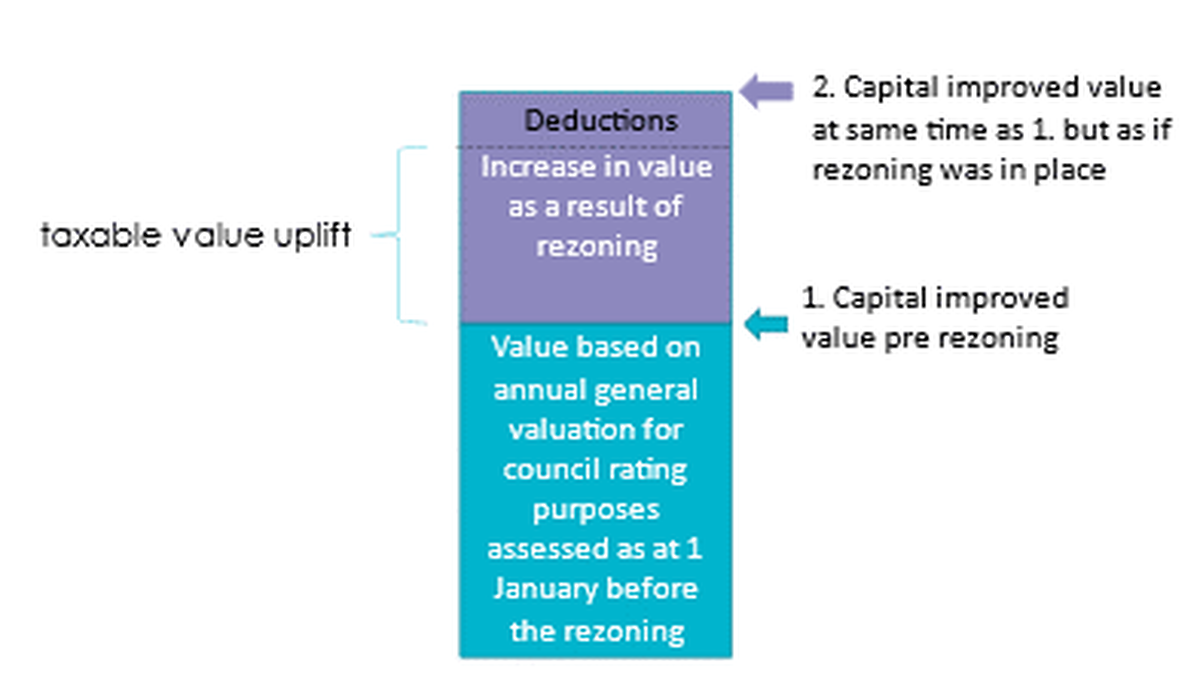
As explained in more detail below, whether there is any liability for WGT, and the amount payable, is determined based on the amount of the ‘value uplift’ attributable to a rezoning of the land. The value uplift is the difference between the capital improved value of the land after rezoning and the capital improved value of the land immediately prior to the rezoning.
WGT is incurred by landowners when their property is rezoned and there is a resulting value uplift, after taking into account any deductions, of more than $100,000.
Property subject to the tax
Exempt land
The main exemption is for residential land, as defined in section 36, of up to two hectares. The land must have a residential building or a building permit to build a residence must be in place. It must also be the only residential land owned by the taxpayer that is rezoned by the WGT event (section 37).
Under section 36 of the WGT Act, residential land does not include land that is occupied primarily as commercial residential premises, residential care facilities, supported residential services or retirement villages. There may be some exceptions for individual units within such premises.
The Commissioner may grant a waiver for a WGT liability for land owned by a charity, if the land continues to be used for charitable purposes for 15 years after the rezoning has occurred (section 41).
Exempt rezoning
Rezonings that may be exempt include:
- a rezoning to correct an obvious or technical error in a previous planning scheme (section 38(1))
- a rezoning from one schedule to another in the same zone (section 3)
- a rezone to the Urban Growth Zone where the Growth Area Infrastructure Contribution applies (section 3)
- the first rezone from a Growth Areas Infrastructure Contribution area after 1 July 2023 (section 3)
- public land zoning (section 3)
- other types of zonings as declared by the Treasurer (section 3(2)).
Transition arrangements
Land may be exempt from WGT if it was subject to a contract or an option that was entered into before 15 May 2021 where the transfer of the land has not been completed prior to the WGT event (section 39). For an option, the terms of the contract had to have been settled at the time the option was granted. Changing the terms of a contract after 15 May 2021 may cause the exemption to be lost such that the WGT is applicable.
There are also some potential exemptions for rezonings that were already underway before 15 May 2021 (section 40).
Who is liable to pay WGT?
The owner of the property, when the rezoning occurs, is liable for the tax (section 8). Where there are joint owners, they will all be liable for the tax as if there was a single owner (section 17). The trustee of a property owned by a trust will be liable (section 18).
The WGT liability remains as a first charge on the land until it is paid (section 42(1)). If the purchaser obtains a relevant certificate (sometimes referred to as a SRO property clearance certificate) from the Commissioner of Taxation the charge on the land will be limited to the amount specified in the certificate (section 42(3)), as is the case for land tax.
When is WGT payable?
Liability to pay the WGT is incurred when the rezoning occurs (section 7).
The owner will receive an assessment notice shortly after the rezoning setting out the amount of tax and when the tax is due.
If the owner of the land wants to defer payment of the WGT liability, the owner must the lodge the deferral application in the approved form, no later than the day before the due date for payment specified in the assessment notice (section 31(2)(b)). The Commissioner does have a discretion to accept an election to defer payment on or after the due date (section 31(3)).
Deferral of the WGT liability accrues interest at the 10 year Australian government bond yield rate.
Under section 32 of the WGT Act, payment of the WGT liability can be deferred until 30 days after the earlier of the following:
- 30 years after the rezoning
- a relevant acquisition occurs in relation to the corporate or unit trust landholder
- a dutiable transaction occurs in respect of the land, such as the sale of the land. There are some specific dutiable transactions that will not bring the deferral to an end as discussed further below.
Transactions that don’t attract duty because of an exemption under the Duties Act 2000 (Vic) may still constitute a ‘dutiable transaction’ in a WGT context and bring an end to a deferral of payment. Practitioners should warn clients about this risk.
Dutiable transactions and acquisitions that don’t trigger the payment of deferred WGT (section 28) are:
- acquisitions of economic entitlements of land
- no consideration dutiable transactions
- land owned and used by charities which is transferred to a charity to be used for charitable purposes
Similarly, some landholder transactions will not trigger the payment of the deferred WGT liability under section 27 of the WGT Act:
- Acquisitions in landholders (i.e. a company or unit trust) that results from a pro rata increase in interests of all unitholders or shareholders (section 27 (a)(i) and (ii) of the WGT Act, and see also section 78(1)(a) of the Duties Act 2000 (Vic)).
- Certain acquisitions of further interests in landholders (section 27(b) of the WGT Act, and see also section 78(1)(b) of the Duties Act 2000 (Vic)).
Notification of errors in the notice of assessment - time limit
Landowners are required to carefully check any notices of assessment and to notify the Commissioner if there are any errors that favour the landowner, such as additional land that should be included in the assessment. Failure to do so can attract penalties.
Under section 26 of the WGT Act, if a landowner is served with a windfall gains tax assessment, they must tell the Commissioner about any rezoned land left off the notice that, at the time of the rezoning, was owned by:
- the landowner
- the landowner and others jointly (where the assessment is for jointly owned land)
- another member of the landowner's group (if the landowner is a member of a group).
The landowner must notify the Commissioner of any errors in the assessment within 60 days of the notice of assessment (see section 26(2)).
Objection to the valuation of the land in the WGT Assessment – strict time limit
Under section 96(1)(cb) of the Taxation Administration Act 1997 (Vic) (TA Act), a landowner may object to the valuation of the land that is used by the Commissioner in the assessment of the WGT liability. For example, the landowner may take the view that the CV2 value is too great or the CV1 value is too low, thus increasing the uplift and the WGT liability.
However, any objection by the landowner to the valuation(s) forming part of the WGT assessment must be in accordance with section 97 of the TA Act, and any objection must be lodged with the Commissioner within 60 days of the notice of the WGT assessment (see section 99 of the TA Act).
Unlike some other state taxes, there is no discretion for the Commissioner to accept an out of time objection (see section 100(5) of the TA Act).
Calculation of the WGT
The WGT is calculated by determining the difference in the capital improved value of the property as a result of the rezoning (i.e. the ’value uplift’).
If the land has been valued for rating or levy purposes, the last assessment before the rezoning occurred is used as the pre-rezoning value. A supplementary valuation is then done as at the same date as the previous valuation - but as if the rezoning had hypothetically occurred on that date. If there is an increase in the capital improved value as a result of the rezoning, this is called the ‘value uplift’. The ’taxable value uplift’ is the value uplift less any available deductions and is used to calculate the WGT. Only taxable value uplifts of $100,000 or more attract WGT.
If an owner has more than one property that is affected by the rezoning, the subject properties are jointly assessed on the aggregate taxable value.
What is the WGT rate?
The WGT rate is nil where the taxable value uplift (the value uplift after deductions) is less than $100,000.
For taxable value uplifts between $100,001 and $499,999, the WGT rate is 62.5 percent. This applies to the amount of the taxable value uplift that exceeds the tax-free threshold of $100,000.
For taxable value uplifts of $500,000 or more the WGT rate is 50 percent. Note there is no tax-free threshold, and this rate applies to the total amount of the taxable value uplift. The rate is lower given there is no tax-free threshold.
| Taxable value uplift | WGT rate | Windfall Gains Tax Formula |
| $0 to $100,000 | 0 | No WGT |
| $100,001 to $499,999 | 62.5% | WGT = (taxable value uplift – 100,000) x 0.625 |
| $500,000+ | 50% | WGT = taxable value uplift x 0.50 |
Impact of section 10H of the Sale of Land Act 1962 (Vic) on conveyancing
Since 1 January 2024, under section 10H of the Sale of Land Act 1962 (Vic) (Sale of Land Act) and subject to section 58 of the Sale of Land Act, if there is an existing windfall gains tax liability in respect the land, then a vendor cannot enter into a contract of sale that contains any terms or conditions requiring the purchaser to contribute any amount towards that existing windfall gains tax liability.
If the contract of sale of land does contain terms or conditions in breach of section 10H of the Sale of Land Act, then those conditions have no effect, and if prosecuted the vendor could be subject to penalty units.
However, if a rezoning event is likely to occur sometime after the day of sale, and for example the WGT liability is likely to crystalise after the day of sale and before settlement, then section 10H of the Sale of Land Act does not apply. In this scenario, the parties could agree to conditions or terms in the contract of sale of land to permit the vendor to recover all or part of a possible or anticipated WGT liability from the purchaser.
Risk management measures
- Solicitors and conveyancing practitioners need to read and understand the WGT legislation.
- Update checklists and precedents to highlight WGT risks and considerations.
- Advise clients as early as possible about the time limits and issues raised in this alert.
- Update precedent advice letters to warn clients of WGT risks and time limits, including:
- the time limit to seek a deferral of the WGT liability, and that if a deferral of the due date for payment of the WGT liability is obtained, that interest accrues in accordance with section 35
- Strict 60 day limit to object to the valuation(s) in a WGT notice of assessment (in accordance with sections 96, 97 and, 99 of the TA Act)
- the actions or events that might trigger the payment of deferred WGT.
- Conduct WGT training for all staff, including conveyancers, who act on real property transactions.
- If acting for the vendor, and subject to section 10H of the Sale of Land Act, practitioners should seek instructions as to whether any anticipated WGT liabilities that may occur after the day of sale are to be recovered from the purchaser, by way of a special condition in the contract of sale of land.
- Practitioners acting for vendors who have land that is subject to a contract or option entered before 15 May 2021, and which may be exempt, need to advise clients that if the contract terms are significantly varied before settlement, the WGT exemption may be lost.
Resources
Windfall gains tax | State Revenue Office
This alert was originally published on 15 February 2022 and subsequently updated on 11 May 2026.